Death isn't a failure of care
My friend, Rachel, who has much more experience with pets than I do, shared an excellent bit of wisdom after Kika died.
Death isn’t a failure of care.
On some level, it seems obvious enough. No one has ever beaten death. Your loved one was supposed to be the first? I don't think so.
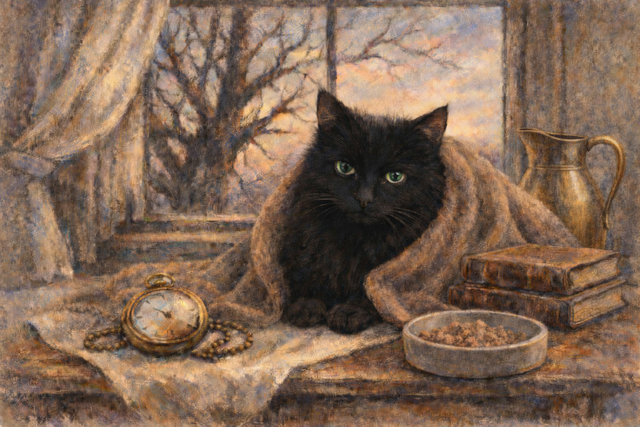
On another level, I find the statement difficult to accept. There's always more that could have been done. I could have timed her medication better. I could have brushed her more to calm her and to express my love. I could have slept by her side those final days, on the floor of my office where she hid at night. I don't know why the idea only occurred to me later. Maybe she would have lived longer if I had. (To be fair to myself, I was pretty confused and exhausted in those final days. Perhaps I couldn't think clearly with her health declining.)
Kika's death
Kika ultimately died of gastrointestinal disease. She may have had lymphoma, but we will never know for sure. Her primary veterinarian felt that certainty was unnecessary, because the treatment for lymphoma was the same as the treatment for other kinds of gastrointestinal disease. We did follow that treatment plan, but it wasn't enough.
I brought Kika in for an appointment the day before she died, on my mother's urging. My mom knew I would never regret going, but I would regret not going. That turned out to be excellent advice. If it hadn't been for that, I would still be second-guessing myself, wondering if Kika had died of acute pancreatitis or something else that I failed to see. The vet took some fluids and sent them to Cornell, but when Kika passed the next day, the practice cancelled the tests. On the day Kika passed, the attending veterinarian did say something about how Kika's fluid looked cancerous under their microscope, but I was so flustered I could hardly understand what she was talking about.
The GI med may have worsened Kika's condition in the end, but I still think trying it was the right course of action. No one could have predicted how she would react to it, and if I hadn't tried it, I would be blaming my avoidance of the medication for her decline.
Even still, I should have been able to extend Kika's life somehow. Every choice matters. In that sense, wasn't her death a failure of care?
I don't know. There are many causes of death in humans and animals. Kika didn't die of the following things, to be clear, but mistakes happen, people die of medical malpractice, and accidents take lives too soon. Are those deaths predetermined? Are they unavoidable?
Maybe they are.
Kika died because she was a living thing, and living things die. Death is the price we pay for birth. Perhaps everything else is secondary—a few days here, a few days there, perhaps more. Immortality? No.
The Mortal Rule
I'm not a Buddhist, but I find Buddhism interesting and Buddhist and Buddhist-inspired meditation indescribably helpful. Buddhism can sometimes seem impenetrable, with myriad traditions, vast terminology, and scripture which is much more voluminous and much more sprawling than Westerners are accustomed to. I recently stumbled across the “Five Remembrances,” though, and they are not at all difficult to understand. They offer a meaningful response to my difficulties, or perhaps a preventative for the feelings I've been struggling with. Practitioners are encouraged to memorize and reflect upon these facts, as interpreted by Lion's Roar and author Koun Franz:
I am of the nature to grow old. There is no way to escape growing old.
I am of the nature to have ill health. There is no way to escape having ill health.
I am of the nature to die. There is no way to escape death.
All that is dear to me and everyone I love are of the nature to change. There is no way to escape being separated from them.
My actions are my only true belongings. I cannot escape the consequences of my actions. My actions are the ground upon which I stand.
The names of others can be substituted in these reminders. Kika was of the nature to grow old. Kika was of the nature to have ill health. Kika was of the nature to die. There's nothing we could have done to change that. (The last remembrance seems like a non-sequitur, but I assume its inclusion partly serves as a reminder of the centrality of karma in Buddhist thought.)
Philosophical stoicism offers similar advice:
With regard to whatever objects either delight the mind, or contribute to use, or are tenderly beloved, remind yourself of what nature they are, beginning with the merest trifles: if you have a favorite cup, that it is but a cup of which you are fond, – for thus, if it is broken, you can bear it; if you embrace your child, or your wife, that you embrace a mortal, – and thus, if either of them dies, you can bear it.
—The Enchiridion of Epictetus, as translated by T.W. Higginson
Dialectical behavior therapy encourages the broader practice of “coping ahead.” Others take solace in remembering the phrase “memento mori.” It's not the Golden Rule, I suppose, but there's enough ancient and modern support for the idea: remember that you and others are destined to die. It has helped me, and it may help you, too.
Watching without failing
In the end, Rachel may be correct. Certainly, insisting that your loved ones overcome death is insisting that you be disappointed. You will not succeed. Even still, that won't make you a failure.